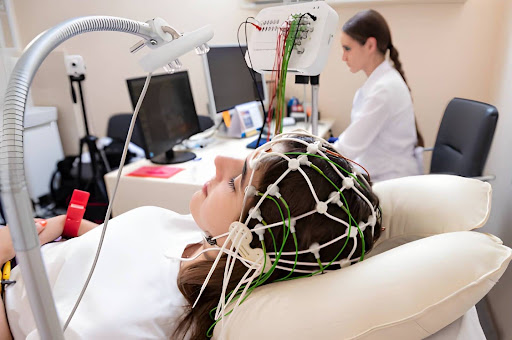
Transcranial magnetic stimulation, or TMS, is best established as a
treatment for depression that has not improved enough with medication.
Because depression and anxiety frequently overlap, many patients ask
whether TMS
therapy for anxiety can help too. The most accurate answer is
nuanced: TMS can improve anxiety symptoms for some patients,
particularly when those symptoms occur with major depressive disorder,
while research on stand-alone anxiety disorders is encouraging but not
yet equally established across diagnoses.
TMS is a prescription medical treatment, not a general wellness
procedure. A psychiatric evaluation is needed to confirm the diagnosis,
review previous treatment, identify safety considerations, and determine
whether a particular TMS protocol is appropriate.
What Is TMS Therapy?
TMS is a noninvasive brain-stimulation treatment. An electromagnetic
coil rests against the scalp and delivers brief magnetic pulses. These
pulses create small electrical currents in targeted areas of the
cerebral cortex, influencing neurons and the networks involved in mood,
attention, and emotional regulation. TMS does not involve surgery, an
implanted device, anesthesia, or sedation.
A standard treatment course is delivered over repeated outpatient
sessions because the effect is cumulative. Family Care Psychiatry
describes its depression protocol as approximately 36 sessions over 6 to
9 weeks, with visits lasting about 20 minutes and no routine downtime.
The exact device, target, pulse pattern, schedule, and total number of
treatments depend on the indication and clinical plan.
How Does TMS Affect the
Brain?
TMS does not simply switch anxiety off. It changes activity in
specific brain circuits. Repetitive TMS may increase or decrease
cortical excitability depending on the frequency and pattern of
stimulation. Depression treatment commonly targets the dorsolateral
prefrontal cortex, a region connected with broader networks that help
regulate mood, threat responses, decision-making, and cognitive
control.
Researchers are studying whether targeting different sides or regions
of the prefrontal cortex can influence anxiety-related networks. The
optimal target and protocol may differ for generalized anxiety disorder,
panic disorder, post-traumatic stress disorder, OCD, or anxious
depression. That is one reason evidence from one condition should not
automatically be applied to every other condition.
Can TMS Help Anxiety
Disorders?
Research suggests potential benefit, but the strength of evidence
varies. A 2022 systematic review and meta-analysis covering 13 studies
and 677 participants found significant improvements in anxiety scores
among patients with generalized anxiety disorder, with or without
psychiatric comorbidities. The same analysis did not find statistically
significant overall improvement for panic-disorder anxiety scores, and
the panic-severity result narrowly missed statistical significance.
A 2025 network meta-analysis of eight randomized trials involving 405
participants also found that noninvasive brain stimulation showed
potential for generalized anxiety disorder. However, the estimates were
based on a relatively small evidence base and had very wide confidence
intervals. This means the results are promising, not definitive.
It is also important to separate primary anxiety disorders from
anxious depression. The FDA has cleared certain TMS systems to treat
depressive episodes and decrease comorbid anxiety symptoms in adults
with major depressive disorder who did not improve enough with
antidepressant medication. That is different from a broad clearance for
stand-alone generalized anxiety disorder, panic disorder, or social
anxiety disorder.
TMS vs Medication for
Anxiety
| Factor |
TMS |
Medication |
| How it works |
Magnetic pulses target selected cortical networks. |
Medication affects neurotransmitter systems throughout the
body. |
| Evidence for anxiety |
Promising but varies by diagnosis; strongest relevance may be
anxious depression and certain cleared conditions. |
SSRIs and SNRIs have established evidence and approvals for several
anxiety disorders. |
| Treatment burden |
Frequent in-office sessions over several weeks. |
Usually taken at home daily with follow-up monitoring. |
| Common drawbacks |
Scalp discomfort, headache, time commitment, and access or coverage
limits. |
Possible gastrointestinal, sleep, sexual, activation, or
discontinuation effects, depending on the drug. |
| Best fit |
Selected patients after a detailed evaluation, often when depression
is treatment-resistant or medication is poorly tolerated. |
Often a first-line option, commonly combined with
psychotherapy. |
This is not an either-or decision. TMS may be added to an existing
treatment plan, and some patients continue medication during TMS.
Cognitive behavioral therapy and other evidence-based psychotherapies
remain central treatments for anxiety disorders.
What Conditions Does TMS
Therapy Treat?
In the United States, FDA-cleared uses depend on the specific TMS
device and protocol. NIMH identifies cleared uses that include
treatment-resistant depression, obsessive-compulsive disorder, migraine,
smoking dependence, and anxiety symptoms associated with depression. A
device clearance for one diagnosis does not mean every TMS machine or
protocol is cleared for every condition.
- Major depressive disorder, particularly when antidepressant
treatment has not provided enough relief
- Anxiety symptoms that occur with major depressive disorder, using
specifically cleared systems and protocols
- Obsessive-compulsive disorder, using an appropriate deep-TMS
protocol
- Certain migraine and smoking-cessation indications with cleared
devices
Research also explores TMS for generalized anxiety disorder, PTSD,
bipolar depression, and other conditions.
Investigational or off-label use requires a careful discussion of
evidence, alternatives, cost, and expected benefit.
Who Is a Good Candidate for
TMS?
A good candidate is defined by the diagnosis, treatment history,
device indication, medical safety, and personal preferences. TMS may be
worth discussing when:
- Major depression has not improved adequately after one or more
appropriate antidepressant trials
- Medication side effects have made standard treatment difficult to
continue
- Anxiety symptoms occur alongside treatment-resistant depression
- OCD remains severe despite evidence-based treatment and an
OCD-cleared protocol is being considered
- The patient can attend frequent sessions and understands that
improvement is not guaranteed
TMS may not be appropriate for people with certain metal or implanted
electronic devices in or near the head. A clinician must review seizure
history, neurological conditions, medications, pregnancy status, hearing
considerations, and all implants before treatment. Insurance approval
also depends on the diagnosis, prior treatments, and plan-specific
criteria.
Risks & Side Effects of TMS
TMS is generally well tolerated, and it does not have the systemic
side-effect profile associated with many medications. Common effects
include scalp discomfort, headache, tingling, facial or jaw muscle
twitching, and temporary neck discomfort. Ear protection is used because
treatment produces repeated clicking sounds.
Serious complications are uncommon, but seizures are a recognized
risk. The risk depends on stimulation parameters and individual factors.
Mania or hypomania may occur rarely, particularly in people with bipolar
vulnerability. A qualified clinical team screens for these risks,
determines the stimulation dose, and monitors symptoms throughout
treatment.
TMS does not usually cause the memory loss associated with
electroconvulsive therapy, and patients generally remain awake and can
resume normal activities after a session. Individual experience varies,
so new or worsening symptoms should be reported promptly.
FAQs
Is TMS FDA-approved for
anxiety?
The answer depends on the exact diagnosis, device, and wording of the
clearance. Certain systems are cleared to reduce comorbid anxiety
symptoms in adults with major depressive disorder. That is not the same
as a broad stand-alone clearance for every anxiety disorder.
How quickly can TMS improve
anxiety?
Timing varies. TMS effects are cumulative, and improvement is usually
assessed across several weeks rather than after one session. The
schedule and expected timeline depend on the protocol and condition
being treated.
Can TMS make anxiety worse
at first?
Some people may notice temporary discomfort, tension, headache, or
activation. Any clear increase in anxiety, agitation, sleep disruption,
or mood elevation should be discussed with the treating clinician.
Can I take anxiety
medication during TMS?
Often yes, but medication decisions are individualized. The TMS team
needs a complete and current medication list because some medicines and
dose changes can affect seizure risk or treatment planning.
Does insurance cover TMS
for anxiety?
Coverage is more established for major depressive disorder that meets
the insurer's medical-necessity criteria. Coverage for a primary anxiety
disorder may be limited or unavailable because evidence and clearances
differ by diagnosis and device.
Is TMS better than
therapy for anxiety?
Not generally. Cognitive behavioral therapy and related
evidence-based approaches remain first-line treatments for many anxiety
disorders. TMS may be an adjunct or a selected option after a diagnostic
and treatment-history review.
The Bottom Line
Does TMS therapy help anxiety? It can help some patients, especially
when anxiety symptoms occur with major depressive disorder. Research on
generalized anxiety disorder is promising, but study sizes remain
limited and optimal protocols are still being refined. TMS should be
matched to a clearly defined diagnosis, a specific device and protocol,
and the person's treatment history. At Family Care Psychiatry, a
comprehensive psychiatric consultation can clarify whether TMS,
medication, psychotherapy, or a combined plan is the most appropriate
next step.